Sangre de Cristo Mountains
The StaircaseThe Sangre de Cristo Mountains are a distant but recurring presence in the landscape of Lizzy Enders’s journey through New Mexico. Their scale makes the country around her seem nearly endless; their changing colors accompany both a burial and her arrival in Santa Fe; and their name, Blood of Christ, turns the sunset into a point where physical scenery and religious interpretation meet.
Scale and Exposure
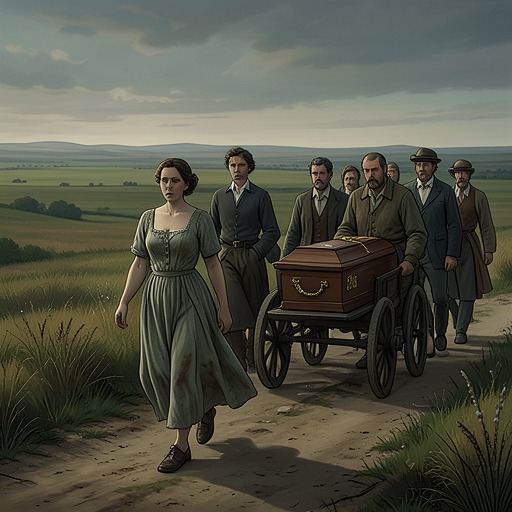
The mountains first establish how small the travelers are in the country around them. During Mama’s burial, the surrounding land seems to go on forever, and only the distant mountains offer Lizzy a measure of human scale. The aspens along their slopes are gold against a darkening sky, while the digging and the quiet voices at the grave seem slight beside the open country. The landscape is not simply a backdrop: its immensity sharpens the loneliness of the burial.
That vastness also belongs to Mama’s last days. Feverish in the wagon, she had told Lizzy that the land had no end and seemed like eternity. Lizzy recalls her fear of its starkness, and the memory makes the country feel both physically open and emotionally difficult to endure. At the graveside, distant western peaks remain bright as darkness approaches, while a coyote wails. The contrast between lingering light and encroaching dark gives the scene its unsettled scale; Lizzy feels that Mama is already gone from the place, and wishes she could leave it too.
Name and Religious Meaning
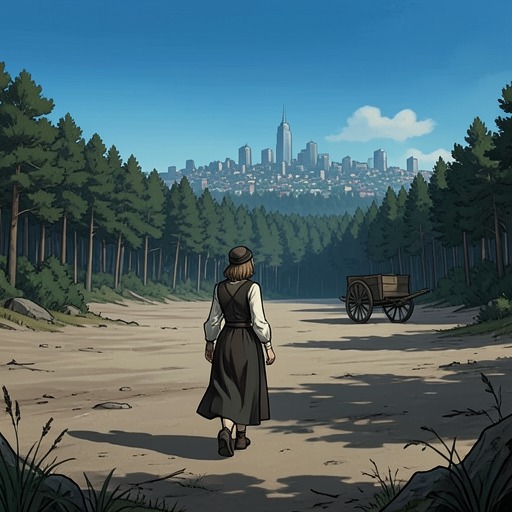
When Lizzy reaches Santa Fe, Mother Magdalena points out the mountains catching the sunset and explains that the conquistadores named them Blood of Christ. The name gives the landscape a religious frame before Lizzy has settled into the convent school. Her inward response is skeptical, but she nods politely: the sacred name does not immediately become her own way of seeing the place.
That distance matters in a novel where religious meaning is repeatedly proposed, practiced, and questioned. The mountains offer a striking image that can sustain the name without proving its spiritual claims. Sunset colors make the naming intelligible as an act of interpretation, while Lizzy’s reserved reaction preserves a gap between the landscape’s Catholic designation and her own unsettled belief.
A Recurring Landmark
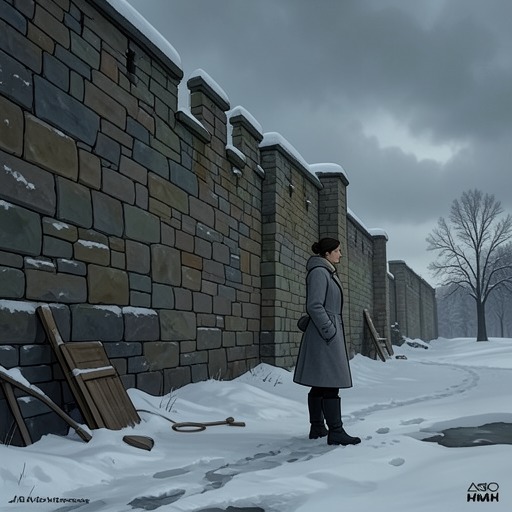
The range remains a practical feature of the country around Santa Fe as well as a symbolic one. In the first week of November, while Lizzy is at Fort Marcy, snow lies on the Sangre de Cristo Mountains to the east. The detail places the action in a particular season and makes the mountains a visible measure of weather and distance. From the fort, the eastern snow and distant grazing sheep contrast with the sun sinking in the west behind the Jemez Mountains.
The landscape also gives shape to Lizzy’s experience of dusk. At Fort Marcy, she feels her grief and losses more sharply as evening comes on, and compares her exposed inner pain to a landscape stripped of its green places. The mountains belong to a wider setting that cannot remove that pain, but their changing light and seasonal snow make the passage of time tangible around it.
Narrative Significance
Across these scenes, the mountains hold together two ways of reading New Mexico. They are material landmarks—distant peaks, autumn color, and November snow—and they are also part of a landscape that characters interpret through memory, fear, and religion. Mama experiences the country’s apparent boundlessness as eternity; Mother Magdalena supplies a sacred name; Lizzy sees the name but does not simply accept the belief attached to it.
The range’s importance therefore lies less in a single decisive encounter than in its recurrence at moments of transition: a mother’s burial, Lizzy’s arrival at the convent, and her visits to Fort Marcy. Its immense scale can intensify grief, while its changing light offers beauty without resolving doubt. The mountains remain present, but what they mean is never entirely settled.